






One of the most violent cities in the World transformed through design
Source: House Builder & Developer
In 1991, Medellin was considered to be the most violent city in the world with almost 20 people being shot every day, and one of the five most corrupt cities of Colombia in the year 2003. Society was marked by violence and a strong sense of inequality. The social classes were very established and the neighbourhoods were not united, rather they were separated according to social levels that divided the population.
In the past years, Medellin has carried out social integration policies with the purpose of reducing violence and forming an inclusive city. An urban lab where they had special care with the quality of public buildings and the design of public spaces. In the words of Jorge Melguiso – one of the central players of the city’s transformation
“the words that defined Medellin were drug trafficking and violence; today they are transformation, optimism, modernization, coexistence, education, culture”.
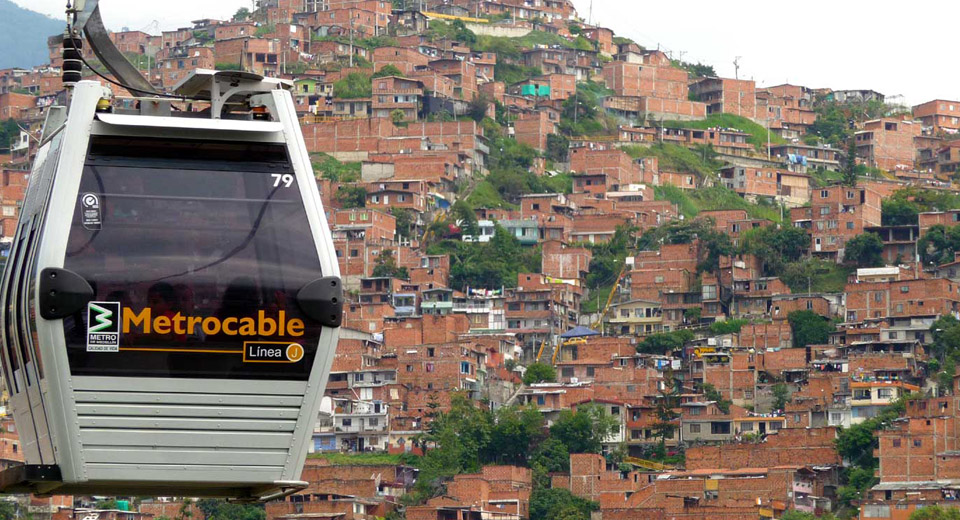
During the past years public infrastructure have been developed to connect the territory’s peripheral neighbourhoods. Pedestrian bridges have been built as well as the iconic “metrocable”, bus routes and soon incorporating a Tram. The most successful intervention were the public facilities in the city. New projects of all scales have taken over public spaces and now also act as meeting spots for the population.
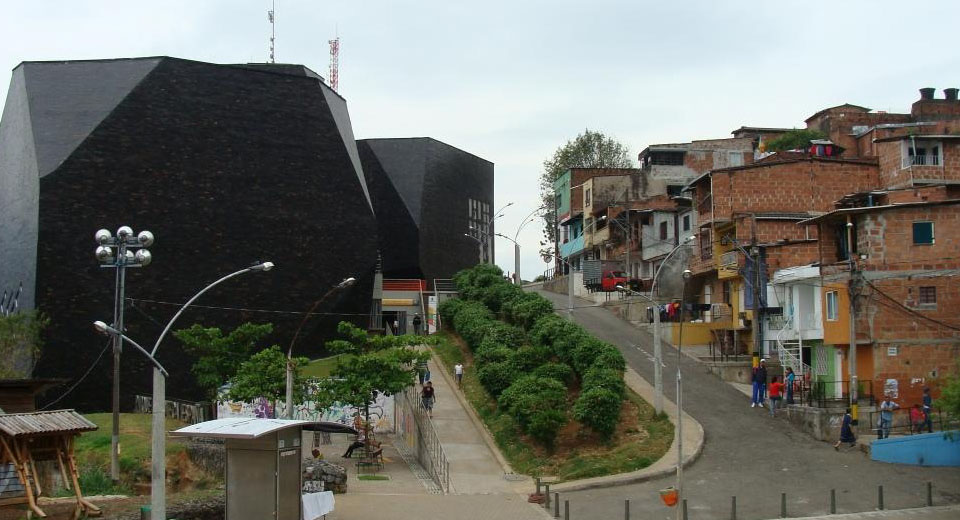
The local government believes education and culture are key factors in the city’s transformation. Having taken these elements into account, the city has progressed considerably, but continues to grow and improve constantly. Nowadays Medellin is an important reference in architecture around the world, and is a perfect example of what is known as social urbanism.
Every year the population of Medellin grows by about 30,000 due to a flow of people from the countryside and into the city. These people usually settle in self-built houses on the mountainside, expanding the city limits in an informal and uncontrolled manner. To relocate a part of this growing population, a contest of ideas in the matter of housing has been designed.
ARCHmedium propose to regenerate the city through a hybridisation of uses in the historic downtown area. Currently, the center of the city is mostly given tertiary use (office buildings and commerce). This project revolves around implementing new residential use and reformulating the adjacent public spaces in a way that includes housing.
The contest forms part of “Piso Piloto” exhibit, which studies possible solutions that guarantee housing in the city. Two exhibits will be put together, one in the CCCB Center of Contemporary Culture of Barcelona and the other in the Antioquia Museum in Medellin. The final objective is the construction of a pilot neighbourhood based on this research.